.png?upscale=true&width=700&upscale=true&name=Cardinal%20Insights%20%20Header%20600%20x%20300%20(3).png)
"Not in a Flood Zone" Are the Five
Most Expensive Words in Real Estate
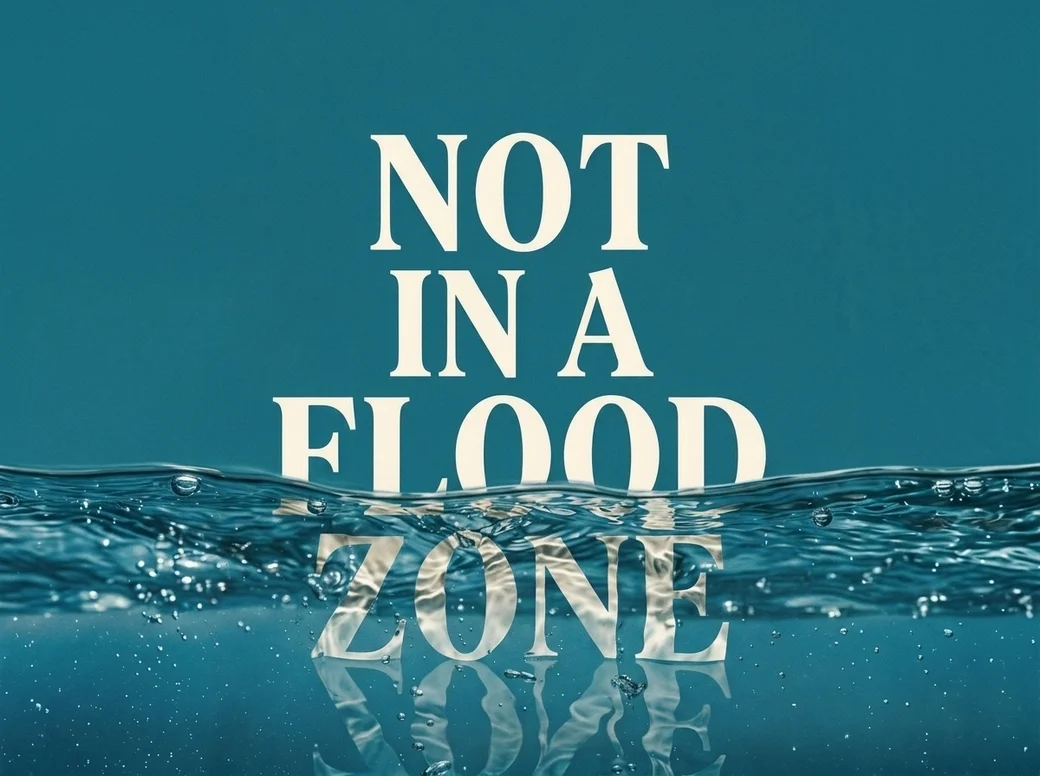
What Helene taught me about the maps everyone trusts — and the seven-years of expense that follows.
Somewhere in your files sits a report declaring that one of your most important facilities is "not in a flood zone." Here is what that sentence actually means: water has not gone there in the recorded past.
It is not a forecast. It was never a forecast.
Western North Carolina learned the difference the hard way. In October 2023, I published a warning that Asheville... ringed by mountains, hours from any coast... faced devastating flooding in the not-too-distant future. Eleven months later, Helene killed more than 100 people in North Carolina, most of them in the western mountains.
I take no satisfaction in the warning I gave. And I want to be clear about something: I got it wrong too. I predicted flooding. I did not predict anything close to what actually happened.
But the prediction itself wasn't clairvoyance. It was just that I was reading a better map than what is readily available.
Where the warning came from
For years, Cardinal has worked with the American Flood Coalition, a nonpartisan group of cities, elected officials, and business leaders focused on adaptation to increased flooding. We've handled their Washington, DC office needs several times over. It's an organization near to my heart, in part because of who they advocate for: small communities that get hit hardest and have the fewest resources to respond.
When you spend time around people who study water for a living, you pick things up. The thing I picked up in 2023 was this: the AFC had Asheville on its list of cities to watch. It was the only one on the list nowhere near a coast.
That detail stuck with me because it cut against everything my readers assume. Flooding is a beach problem. A lowcountry problem. Not a Blue Ridge problem.
The locals knew better. Western North Carolina has generational memory of deadly floods; walk into a coffee shop in North Wilkesboro and the walls are lined with photographs of the flooding that killed people there in the 1940s. The false comfort belonged mostly to newcomers... including, ironically, people who moved to the mountains from the coast to get away from climate risk.
Then Helene arrived, and it was beyond what even the people with the longest memories could have imagined.
The map problem
Here's the framing you should understand, and it applies to your property whether you're in Asheville, Charlotte, or Dallas.
FEMA flood maps are historical documents. They tell you where water has gone, based on rainfall records that in many regions are decades old. The federal precipitation dataset most engineering and floodplain decisions rest on is called Atlas 14, and portions of it predate the smartphone. Its replacement, Atlas 15, is being built to look forward instead of backward... but it isn't fully deployed yet.
So the line on the map that your lender, your insurer, and your broker all trust was drawn from a rearview mirror. Meanwhile, the rain is changing faster than the paperwork. First Street Foundation research found that one in nine U.S. residents faces significant risk of storms delivering at least 50 percent more water than their local infrastructure was built to handle.
"OK, but that was the mountains. My properties are in the city, with modern stormwater."
Fair. Two answers.
First, the mountains were supposed to be the safe place. Backward-looking maps produce backward-looking confidence, wherever you are. The question worth asking is not "am I in the zone?" but "how old is the rainfall data behind that line on the map?"
Second, flooding is a watershed problem, not an address problem. Charlotte can invest millions in stormwater capacity and still take water from upstream communities that can't afford to do the same. Right here at home, Bojangles moved its headquarters out of a building it occupied for more than 20 years because Sugar Creek kept leaving its banks. I know that deal from the inside... I represented the landlord when Bojangles relocated into 61,000 square feet at Forest Park Five, its new headquarters. That's not a mountain story. That's a mile from where many of you are reading this.
The risk nobody underwrites: the recovery
Here's what trusting the old map actually costs you. It isn't just the water damage. It's the cost of clean-up and downtime that can last for many years.
Nearly two years after Helene, waterways across western North Carolina remain clogged with debris... and that debris, piled high along stream banks, now has local leaders as worried about fire as they are about the next flood. The disaster keeps writing new chapters long after the national cameras leave.
Then-Speaker Tim Moore called what's ahead for western North Carolina a "generational recovery." If that sounds like political language, consider a smaller example: the federal courthouse in Wilmington, damaged by Hurricane Florence in 2018, did not reopen until 2025.
Seven years. For one well-funded federal building. Seven years of Federal courts operating in a Wilmington warehouse.
If your critical facility... the plant, the distribution center, the data center... went offline tomorrow, your insurance models the damage. Almost nobody models the duration. Business interruption measured in months and years, not weeks, is the line item that turns a weather event into a balance sheet event.
The math the CFOs should see
Three months before Helene, the U.S. Chamber of Commerce, Allstate, and the U.S. Chamber of Commerce Foundation released a study called The Preparedness Payoff (June 2024). The finding: every $1 invested in resilience and preparedness saves communities $13 in damages, cleanup costs, and economic impact.
Their 2025 follow-up inverted the frame, and the inverted number is the one I'd put in front of a board: every dollar NOT invested before a disaster can cost up to $33 in lost future economic activity.
Resilience spending reads as an expense right up until the water arrives. Then it reads as the cheapest money anyone ever spent.
Three questions worth asking this quarter
- How old is the data behind the flood designation on our facilities? Ask when the underlying rainfall study was published. The answer will surprise you.
- What is upstream of us, and who is paying for its stormwater infrastructure?
- If a critical facility went down for 18 months, not three weeks... what breaks?
I wrote about this risk a year before Helene, and even then I underestimated it. Take that for what it's worth.
Do you have questions about how flooding may impact your critical facility? Give me a call and I'll connect you with the right people.
Cardinal Real Estate Partners | 704-900-0900 | www.Cardinal-Partners.com
P.S. Real estate decisions are high-stakes and the incentives around you aren't always aligned with yours. My book, Go For Broker, is available on Amazon... or reach out and I'll send you a copy, free.

Ways to Connect
Do you want to know more? Got a topic you’d like to see discussed here? Shoot an email to jculbertson@cardinal-partners.com or call 704-900-0900.
CONTACT US